“Secret” Audiences Deserve a Prequel

After viewing The Secret, the consensus here in the balcony is that the producers must be planning to reveal the entire “secret” at a later date. While I’m sympathetic with the position that the masses probably can’t handle the full “secret” in one sitting, I’m not sure that the Law of Attraction is the most logical or effective opening scene. In fact, it’s closer to the denouement.

Trying to create or change the scenes in your life’s drama by using only one tool in the box is like playing nine holes of golf with only one club. Fewer things can be more harmful to the body, mind or spirit than learning the Law of Attraction without context, and practicing it in isolation and out of sequence.

As The Secret explained, wise souls have known this Law for many millennia. Since then, they and their messengers have faithfully spread the word. In the 20th century, Earl Nightingale became the first to record this wisdom on vinyl, crediting these not so New Age sages for his “We become what we think about” mantra.

Oprah, perhaps history’s most prolific messenger, knows and shares the Law of Attraction extremely well. Did she consciously practice it to transform her life from an unhappy, abused child with low self esteem into that of a highly respected, internationally known talk show host and billionaire? Frankly, I doubt it. I think she’ll admit that her lifestyle today was beyond the wildest imaginings of a woman who once told me that she couldn’t balance her checkbook.

Oprah and I worked at the same Chicago television station for years. When she arrived at our station, she didn’t envision that her enormous talent would redesign the TV talk show landscape forever. In fact, she was stunned when our station manager offered her the job as the AM Chicago host.

Oprah quickly stole the hearts of Chicago viewers, and advertisers stampeded for exposure to her huge audiences. Then the station manager proved that he was more than a great talent scout. He changed her air time, renamed the show and decreed that the new Oprah Winfrey Show would now challenge the venerable Phil Donahue, head-to-head.

Oprah told us that she was petrified. She feared that Donahue would obliterate her from the airwaves. Fear was her prevailing thought. But in no time flat, she reduced Donahue to Dona-who? Was Oprah working the Law of Attraction?

Few, if any, have focused our attention on developing a debilitating or deadly disease, being downsized, losing our homes and loved ones to an accident, wildfire, hurricane or tornado, or our pensions to unscrupulous corporate executives—but it happened, anyway. On the other hand, many have connected emotionally with vivid images of what their lifestyle would be like if they won a big lottery jackpot, married the mate of their dreams, landed a great job or received an admission letter to the college at the top of their list—yet it never materialized. How many have followed the directives in The Secret and received disappointing results?

I speak from experience. More than a decade ago, I followed these same steps, based on the teachings of the sages that inspired The Secret. I outlined that drama and its results in EARTH Is the MOTHER of All Drama Queens. I learned the hard way that a little bit of information can be a dangerous thing.

Is the Law of Attraction all we need to know? Is it even the first thing we need to know, if we want to take control of our lives? What’s the rest of the secret—the prerequisite lessons that support this Law? The ancients have passed on that information, too; and it’s just as accessible.

Let’s hope that the producers of The Secret unveil it in a desperately needed prequel—and soon. Otherwise, many who are now open to exercising the power of positive thought and invoking the Law of Attraction to control their outcomes will lose ground and lose faith when they don’t consistently create the results they desire, as The Secret has promised.

Are We Digesting Conflicted Fruit?

Today we celebrate the greatest lesson demonstrated by perhaps the greatest teacher the world has ever known, a Jew named Yeshua. What he demonstrated more than 2,000 years ago was that there is no death.
He reportedly revealed that even though the physical bodies we wear are lifeless and entombed, we are not dead. We are immortal spirit, made in the likeness and image of our Father. We are not physical bodies. What we learned from his demonstration is dramatically different.

Yeshua, whose name was mistranslated as Jesus, was a powerful teacher who was committed to sharing the Truth as it had been revealed to him. Through parables and folksy stories, he spread the word about an unconditionally loving and eternally forgiving God. It was a soul-stirring, joyful message that resonated in hearts wherever he went. But as the Bible relates, some of the questions his followers asked reveal that they were also confused by his message.

Like Yeshua, his followers had been reared in the Jewish tradition. Many had committed Jewish law to memory and were expected to live by the letter of that law. So, despite their acceptance of Yeshua’s dramatically different perception of what God is and what God does, his followers didn’t completely replace their old beliefs. Instead, they planted Yeshua’s empowering and revolutionary teachings on top of the lessons they’d learned as children. We’ve been harvesting conflicted fruit ever since.

For example, Yeshua believed that God not only is absolute (unchanging), he believed that God loves us unwaveringly and forgives us unconditionally. In his Prodigal Son parable, he portrayed God as a Father who will welcome us Home with open arms, no matter what we’ve done.

By contrast, the religious tradition of Yeshua’s family portrayed God as a violent, angry Supreme Being who demanded us to slaughter an innocent creature to atone for our errors. Today, such live sacrifices are considered barbaric and acts that are frequently associated with satanic rituals.

It begs the question: Have we digested conflicted fruit? Or do we truly share Yeshua’s belief that:
1. God is always the same and has never changed;
2. God has always been unconditionally loving and forgiving;
3. God doesn’t heinously punish an innocent for another’s wrongdoing?

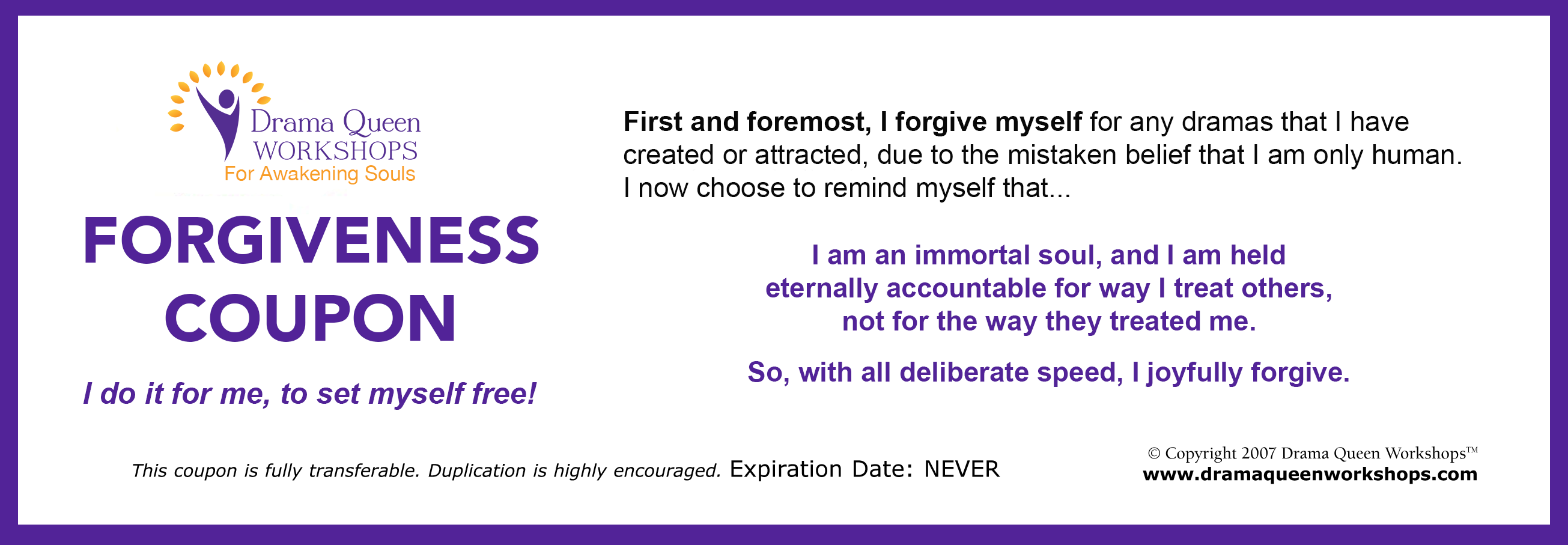
Downloadable DQW Forgiveness Coupon

Your Forgiveness Coupons

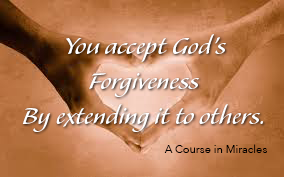
You accept God's forgiveness by extending it to others.-A Course in MiraclesMost of us believe that we’re granting someone a favor when we forgive them. In reality, we’re doing ourselves a favor: We’re freeing ourselves from the grip of any negative energy associated with the incident.

When we forgive others, we also are making a conscious choice to defer to what some call the Law of Reciprocity or the Law of Attraction. In other words, karma: Souls reap what we sow; we receive what we’ve given—in equal measure. It isn’t punishment or reward; it’s merely balance. It’s divine fairness. Why do we think God would do anything less than that?

Forgiving others also is a conscious decision to heal ourselves so that we can progress on our path, instead of being stuck in someone else’s stupidity. Forgiving someone does not endorse or excuse their behavior. And it does not let them off the hook. They own their behavior, and they alone will be held accountable for everything they do.

Life provides plenty of opportunities to experience the transformational power of forgiveness. I eagerly encourage you to reap the benefits of the practice (and it is a practice). Be very clear that the only way you can practice forgiveness is to attract a series bad actors onto your path, so be mindful when these opportunities arise.

Years ago, I created Forgiveness Coupons for one of my workshop groups. (I was surprised that the coupons were such a hit among the men!) At their request, I posted the coupons on my website so that everyone could replenish their supply.


I offer you the same opportunity. Download the coupons as often as necessary. Share them freely. Heal.

And don’t forget to heal yourself! When someone forgives you, the gift of release is theirs—not yours. So don’t forget to make the magic happen for you, too. Forgive yourself—I mean sincerely and completely forgive yourself—for all of the times you’ve done things to others that you would not want done to you. And validate your sincerity by consciously choosing to interact with others in a manner today that does not require self-forgiveness tomorrow.

I Wish Jesus Had Dropped Bread Crumbs

Humans are a lovely and loving lot—except when we forget we are. And that memory lapse scripts all human drama.

From the missives in my e-mailbox, there’s many a beautiful soul out there who believes that it is his or her mission to save the rest of us from eternal damnation; and by golly, they’ll do it by force, in the name of Almighty God. They’ll shake us, insult us, slap us and zap us until we abandon our belief that God is infinitely bigger—and better—than the ancient scribes portrayed. If we really loved God—I mean really, really loved God—we’ll forward their guilt-tripping e-mails to everyone in our address book, and know that a blessing is on the way.

I have no doubt that these wonderful people really mean well. They truly believe that when God does things that are judgmental, inhumane, punitive and…er, ungodly, it’s for our own good. Hey, drastic times call for drastic measures. That’s why they practice Coercive Christianity. If they didn’t, the rest of us would go to hell in a hand basket.

I received an e-mail yesterday that pimp-slapped those who believe the claims in hoax e-mails, but don’t believe that the Bible is the inerrant word of God. (It didn’t address the group that believes neither.) This type of e-mail used to irritate me. I guess I’m mellowing. Now, I simply wonder how closely these beautiful people have read the Bible—or what’s left of it—before imposing such harsh judgment on others.

In his utterly fascinating book, Misquoting Jesus: The Story behind Who Changed the Bible and Why, renowned biblical scholar Bart D. Ehrman says, “[T]he vast majority of Christians for the entire history of the church have not had access to the originals, making [the scribes’] inspiration something of a moot point. Not only do we not have the originals, we don’t have the first copies of the originals. We don’t even have copies of the copies of the originals, or copies of the copies of the copies of the originals. What we have are copies made later—much later. In most instances, they are copies made many centuries later. And these copies all differ from one another, in many thousands of places.”

You don’t have to be an historian or biblical scholar to notice that there are several versions of the Noah and the Ark story clumsily squeezed into the book of Genesis. Close your eyes and let a child read it aloud. You’ll be surprised to hear things you haven’t noticed in all the years you’ve been reading the Bible or repeating that story. You’ll discover that the details and numbers conflict, from one verse to another—repeatedly.

The New Testament has its issues, too. There are four conflicting accounts of Jesus’ birth, life, ministry, and even his death. That’s because Matthew, Mark, Luke, and John had different perceptions of Jesus and his mission, were talking to different audiences, and trying to convince those audiences of different things.

Matthew was speaking to religious Jews, and made an effort to connect Jesus to Jewish scripture. He portrayed Jesus as fulfilling Jewish prophesy—royalty, the King of Kings. Mark addressed the Romans, presenting Jesus to them as servile, the bearer of man’s burdens. To Luke, the erudite Gentile (non-Jewish) physician, Jesus was the perfect and sinless son of man. Luke was believed to be a friend of Paul. His book targeted a non-Jewish Christian audience. By contrast, John’s message was for the common man, particularly the needy. John viewed Jesus as the perfect son of God. Needless to say, the four covered all the bases.

For many millennia, schools of theology have taught our ministers truths about the Bible that many have forgotten to pass on, including the fact that none of the gospel writers actually knew Jesus. Despite the similarities in their names, Matthew, Mark, Luke and John were not the Apostles. In addition, few men were literate in Jesus’ day. Consequently, the New Testament never contained direct quotes, and neither do our current red letter editions.

Ehrman, who became a born again Christian as a teen, tells a humorous story about how his theological studies fine-tuned his beliefs. (At least, I thought it was funny.) At the urging of the young teacher responsible for his enlightenment, he decided to study Scripture full time. Following high school graduation, he entered Moody Bible Institute in Chicago.

Ehrman considered Moody’s curriculum as “hard core Christianity, for the fully committed.” It was there that he first learned that “none of the copies of original scripture is completely accurate, since the scribes who produced them inadvertently and/or intentionally changed them in places.” All the scribes did this, he was taught.

Despite this insight, Moody students and instructors were required to sign a statement declaring that the Bible was the inerrant word of God. No one else seemed to have a problem with viewing the inaccurate copies of copies as the inerrant word of God, so he accepted it, too.

Ehrman was fired up, following his three year Bible immersion at Moody. He wanted to evangelize to the secular world. He decided to earn degrees that would enable him to teach in secular settings. First step: a bachelor’s degree. He selected Wheaton College in suburban Chicago, alma mater of famed evangelist Billy Graham—ignoring warnings from Moody colleagues that he’d find no “real” Christians there.

His study of Greek at Wheaton highlighted his concerns about the biblical translations. As he approached graduation, he was compelled to devote himself to studying the New Testament. The world’s leading expert taught at Princeton Theological Seminary. Ehrman headed in that direction, ignoring warnings from friends at Wheaton that he’d have trouble finding any “real” Christians at Princeton.

He recalls that he reached a turning point during his second semester at Princeton, after writing a final term paper for a much revered and pious professor. In that paper, he examined a passage in Mark 2, in which the Pharisees catch Jesus and his disciples eating grain during the Sabbath. Jesus defended himself and his apostles by citing 1Samuel 21:1-6, which told the story of King David and his men. The scripture says that they went into the temple when Abiathar was the high priest, and they were so hungry that they ate bread that was exclusively for priests.

Scholars who have studied the Bible in conjunction with other historical texts say this scene actually happened when Abiathar’s father, Ahimelech, was the high priest—a factual error. Ehrman faced this challenge by writing a lengthy and admittedly convoluted argument that the names in 1Samuel and Mark 2 were indeed incorrect, but the Bible itself is inerrant.

His pious professor minced no words, writing on Ehrman’s term paper: “Maybe Mark just made a mistake.” (That’s when I laughed.)

Laypersons such as myself might not be able to spot the thousands of conflicts that scholars have found, but we can clearly see the obvious ones. For example, Matthew’s “inspired” story of Jesus’ birth, written 38 to 68 years after the crucifixion, says that Jesus was born at Mary and Joseph’s home in Bethlehem, and a brilliant star in the East led three wise men to the newborn and his mother. He writes: “Going into the house, they saw Mary and the baby, and fell down and worshipped him.” (Matthew 2:11)

Luke was inspired to relate a totally different birth narrative. In it, Mary and Joseph didn’t live in a house in Bethlehem. They traveled to the city (presumably from Nazareth) to pay taxes. The reason for the trip, Luke claims, is because Joseph belonged to the lineage of King David.

In Luke’s version, it was not the three magi, but shepherds who were led to newborn Jesus—and not by a star, but by an angel: “Ye shall find the babe wrapped in swaddling clothes, lying in a manger”. (Luke 2:12)

Historians have been unable to find any evidence of such a mandate for taxpayers to travel to their ancestral home to pay taxes—ever. Tax time wasn’t recorded to be in December, either. Personally, I’m looking for the rationale for making a pregnant woman travel by foot and donkey to watch her husband pay taxes.

But Luke had to devise a way to get this family from Nazareth to Bethlehem, because Hebrew Scriptures portended that the Messiah would be born in Bethlehem. Jewish prophesy also said that the Messiah would be a descendant of David, so Luke claimed that Joseph was that descendant.

(Cue the screeching brakes) Does this mean that Christmas pageants and Nativity plays the world over are portraying Joseph, not God, as Jesus’ father?

So much for the biblical issues surrounding Jesus’ birth. Let’s look at the Gospels’ dueling versions of his death. Mark, who was the first to chronicle Jesus’ life, 35 to 45 years after his death, claims that Jesus was crucified the day after the Passover meal (Mark 14:12). By contrast, the Gospel of John, which scholars say was written 25 to 30 years after Mark’s version, claims that he was crucified the day before the meal (John 19:14). There are also conflicting reports of the series of events that followed his death. The contradictions are too numerous to mention here.

As the Reverend Dr. Evelyn Boyd-Castillo, one of my favorite teachers at Christ Universal Temple, says, “There’s a lot of truth in the Bible, but everything in the Bible isn’t true.”

For one thing, Jesus can’t be born in different places or die on different days. But more important, believing that the Bible is inerrant doesn’t make us “real” Christians. Reading it for guidance in practicing the teachings of the Jew named Yeshua, whose name was changed to Jesus in one of the many translations, is what makes us “real” Christians.

Yeshua brought good news that has long outlived his time on Earth: God is not the sun or an object, as believed by Roman pagans. And God is not the intervening, score-keeping Bogie Man who angrily smites, vengefully commits genocide, heinously demands the live sacrifice of animals, as described in the Old Testament.

Even though Yeshua’s actual words were never recorded verbatim, their essence was this: God is Love. God is Spirit. God is unconditional forgiveness. God is within everyone. God is good all the time; and all the time, God is good. That was his story; and he stuck to it, no matter what.

For three very challenging years, Yeshua dutifully served as God’s PR person. That’s an awfully short time to change centuries of firmly entrenched images and perceptions of what divinity looks like, especially if the religious establishment virulently opposes you. He knew that mere words wouldn’t do; so he put on a show and took it on the road. He demonstrated what it looks like to exude the real power of the Loving, Living God that is within us: a power that compels us to treat others the way we’d want to be treated, love and forgive unconditionally, and honor free will, forcing no one to do anything.

He issued no commands. Instead, he gently and lovingly extended an invitation for us to mimic his thoughts, beliefs and behavior beyond his space and time.

“Follow me,” he urged.

Sigh. If only he had dropped bread crumbs.

Dare to Think?

“Mankind must evolve, for all human conflict, a method that rejects revenge, aggression and retaliation. The foundation of such a method is Love.” The Rev. Dr. Martin Luther King, Jr.

My route to the office passes a large orange sign in a window of the McCormick Tribune Freedom Museum on the Mag Mile that screams: “WE DARE YOU TO THINK”. That sign always makes me giggle.

Thinking is often discouraged or forbidden in this Land of the Free, especially when it comes to religion. Typically, we are scared to think, rather than dared to think.

Suppose you have a friend who makes you feel lucky to have him in your world. In fact, everyone who knows this guy speaks of him with admiration. What a cool dude: kind, generous, trustworthy, always lending a helping hand to others. He’s a source of comfort and solace. You’ve never seen him angry or heard him utter a discouraging word.

Then one morning you pick up the newspaper and see his picture beneath a headline that screams “CHARGED!” He’s walking with his head bowed, dressed in an orange jumpsuit, hands behind his back and surrounded by a gaggle of police and TV cameras.

Your knees buckle as you read details of the crimes your dear friend is accused of committing: rape, murder and child abuse. Investigators say they also found evidence that he is involved in a terrorist plot to kill a great number of people.

Your head is spinning. Do you believe what you read—or trust what you know? That is our challenge when we read certain accounts about God: believe what we read or trust what we know.

If, as the Rev. Dr. Martin Luther King, Jr. suggests, mankind must evolve beyond a barbaric level of conflict resolution, surely God is light years ahead. And if we share Dr. King’s belief that we evolve to a higher level of conflict resolution through love, and we believe that God is Love, is it possible to believe that God resolves conflict with revenge, aggression and retaliation?

We are dared to think.

When I was nine or ten years old, I recall leaving Sunday school a bit dazed. I couldn’t quite wrap my child’s brain around what I’d just read in class. I comprehended the God is Love part; but the book lost me when it claimed that God had done cruel and unusual things that Love absolutely positively would not do, under any circumstances.

We are dared to think.

I’ve been told that God is everywhere, knows everything, and is all-powerful. If that’s true, how are we also supposed to believe that God has a rival? A rival can only be taken seriously if it is an equal. God has no equal.

We are dared to think.

One thought always seems to lead to others: For example, if jealousy is such an undesirable human trait, how can we believe that God has claimed to be jealous? And pray tell, what exists in the Universe that would invoke jealousy from a God who is everywhere, knows everything, and is all-powerful?

We are dared to think.

It is claimed that Love had a fit of rage so intense that it killed everyone and everything in Creation, with a few exceptions. And they want us to believe that Love has threatened to do it again.

Anybody dare to reflect on that “revelationary” method of resolving conflict?

Leaping into the Procrustean Bed

If it weren’t for the occasional leaps in logic, I swear, some of us wouldn’t get any exercise at all. OK, nobody knows my name at the nearby health club, either; but I do try to give my brain a workout several times a day. In fact, right now it’s running wild with speculation over how the U. S. Conference of Catholic Bishops will react this week to the “proposed guidelines for ministering to homosexuals.”

According to a report in the Chicago Tribune, when America’s Roman Catholic bishops convene in Baltimore for their annual fall meeting, they will review new guidelines that absolve gay Catholics of any obligation to try to alter their sexual orientation. That’s a big step. But, while the bishops who drafted this proposal appear to acknowledge that homosexuality is an orientation, rather than a choice or a lifestyle, they’re simultaneously recommending that the Church continues to stress that same-sex relationships are immoral.

I really should rest my brain after that impressive workout. Leaping is one thing; bungee jumping is quite another. With the little strength that I have left, I absolutely positively must ask:

1. If same sex orientation is something that
one cannot change,
2. The Church will not obligate anyone to even try
to change,
3. Then, why is same sex orientation considered
immoral?

Is it because Leviticus said so? Are these upstanding Christians saying that Leviticus’ hate-filled laws trump Jesus’ good news? Judge not, lest ye be judged.

The answer cometh with rapid speed:

“We are trying to find a language that does not betray the teaching of the Church, but will perhaps express it in ways that are not so offensive,” the Tribune article quotes Chicago’s Cardinal Francis George, vice president of the U.S. Conference of Catholic Bishops, as saying.

Further muddying the waters, he reportedly added, “The conclusions are the same. The language will be less painful than sometimes the language has been in the past.”

Have mercy! I shouldn’t have scrimped on those stretches before I began this ecclesiastical workout. And for rest, they offer me the comfort of a Procrustean bed. In fact, Procrustes is probably gleefully flattered that they’ve imitated him so well.

Don’t remember Procrustes? He was a rather sinister fellow in Greek mythology, a proverbial nightmare to weary travelers whose route took him near his place. Appearing to be a hospitable gent, Procrustes would invite them to lodge at his place. In exchange, they had to do nothing—except fit in his iron bed. I mean, literally fit in his iron bed: If they were shorter than the bed, he’d stretch them to its length. If they were taller, he’d chop off their head or legs. Of course, no one ever truly fit it, because once this diabolical charmer spotted them from a distance, he’d simply adjust the length of the bed. That gave birth to the term “procrustean bed”: an arbitrary standard to which exact conformity is forced [emphasis added].

When a church body believes that God is forceful, punitive and judgmental, rather than powerful, forgiving and the grantor of free will, it promotes policies that reflect their belief, as evidenced by two other proposals the bishops will consider this week: One forces gay couples to agree to raise their adopted children Catholic, otherwise their parish might not allow the children to be baptized. The second lays a foundation that would make it easier for clergy to deny holy sacraments to Catholics at odds with the church (baptism, confirmation, communion, confession, holy orders, marriage, and last rites), thus forcing parishioners to be in lock-step or be locked out. Among those targeted: politicians who call themselves Catholic.

The procrustean bed. A most fitting foundation on which the good bishops should begin this week’s meeting in Baltimore, and as painful on the 21st century stage as it was in ancient myth.

Power vs. Force


I’m not one who likes to watch news about tragedies. It’s probably all those years I spent producing and reporting TV news that makes me scream, “Enough is enough!” After seeing only a few minutes of a report on the Amish schoolgirl murders in rural Pennsylvania, I’d certainly seen enough—enough to be moved to profound admiration for these people whom most consider a little odd. When you think about it, I guess it is a bit odd for Christians in America to actually practice Christianity. But these people do. And they do it unflinchingly, naturally, and with conviction.

In the face of unspeakably demonic horror, most of us don’t stop to ask, “What would Jesus do?” Members of this Amish community didn’t either. They didn’t have to. They knew the answer and they revealed it to the world: Jesus wouldn’t respond with rage or retaliation. He would not be bitter and he would not lose his faith in God. From everything we know about Jesus, we know that he would unflinchingly and naturally forgive; and he’d do it with great conviction.

As Rita Rhoads, a local nurse and midwife who had delivered three of the young female hostages, told NBC News’ Ann Curry, “God said, ‘I will forgive you as you forgive others’ And we truly believe that.”

Obviously, the rest of us don’t. Many of us believe that forgiveness is not freely granted. There is a cost. It is a reward for meeting our conditions: “I’ll forgive you if… I’ll never forgive you because…” That’s the position we take when someone violates or betrays us. And we decide to punish them by withholding our forgiveness for hours, days or forever.

When we plant seeds of forgiveness, we reap forgiveness. What do we reap when we withhold forgiveness? So who is really being punished when we refuse to forgive? Do we really understand what “Forgive us our trespasses AS we forgive those who trespass against us” means?

This Amish community obviously understands that extremely well, as evidenced by those who went to the home of the murderer’s family—to comfort, not condemn. One of them reportedly held the murderer’s father in his arms for an hour, and told him, “We will forgive.”

Ms. Rhoads summed it up quite nicely, “There are two things that happen with your faith: Either you let it go and you get bitter, or you grow stronger. We’ll grow stronger. When you have Christ in you, that’s what happens.”

And what happens to those of us who think that God and Christ are far, far away, rather than an accessible source within?

The answer is clear. We have tons of technology in the world surrounding the “plain people” in that rural Amish community. But what this heartbreaking human drama revealed, more than anything else, is that we don’t have nearly as much Power.

Why Bad Things Seem to Happen to Good People


If God doesn’t cause or sanction human suffering, how do we explain 9/11 and other tragedies that visit truly wonderful people?

I’ve been pondering this question, since receiving word the other day that a longtime friend was recuperating from breast cancer surgery. She’s the latest in my circle of really awesome friends to encounter this experience.

Like any red-blooded spiritual sleuth who fervently believes that the Universe is orderly and that everything happens for a reason, I couldn’t resist the urge to search for the reason that bad things sometimes happen to good people. The only thing I knew, for sure, was that the reason was going to be a good one.

Where to look? I had two options: Either I could peer through the easily accessible “God allows bad things happen to good people” theater glasses, or I could make that arduous climb into the balcony, where I keep my panoramic “God is good all the time” lenses. It was a no-brainer. You can only see part of the picture through those earth-bound theater glasses, so I clambered into the balcony.

Wow, what a spectacular view! It never changes. No matter what time of day or night, it’s always the same; so reliable, it’s absolutely comforting.

I mentally focused on a scene that would correlate to the challenge my friend was experiencing. I was drawn to the image of one brilliant soul. Like the others, its radiance completely overshadowed the physical body it was wearing; but I knew that this one had something special to share with me. I scooted back in my seat and waited for more. Gradually, the story began to unfold.

I watched this beautiful soul leading its body through a transformative experience.

“Why?” I asked.

“Balance,” it told me. It was offering her an opportunity to be still, to focus on her inner Light, to listen to her inner self—listen, rather than think. Listen, rather than speak. Listen, rather than work.

Ultimately, it said, all physical illness presents us with an opportunity to embrace ourselves with unconditional love, to see and feel dysfunction, and love ourselves anyway. Love is one of the most potent healers in Life.

I thought about that. When we’re busily flitting about the planet, working on this project, solving that problem, helping this organization or that person, our minds are totally focused on images and circumstances outside of ourselves: the work, the people, the bills, the traffic. Even when we look in the mirror, we are looking outside of ourselves. We barely know ourselves, and rarely love ourselves.

We’ve been misled into believing that we’re bodies, merely imperfect impermanent bodies. Unfortunately, Loved Ones, the creators of that tale thought the world was flat, too. They treated animals and people barbarically, and justified it by saying that God behaves the same way. I don’t know about you, but that raises a credibility issue for me.

Until someone offers evidence that disease, murder, accident, or even terrorism can end our invisible eternal lives, or that paramedics or surgeons can save our lives, I will maintain th belief that the only thing that can be terminated or saved are our bodies, the constantly decaying costumes that our invincible souls wear from time to time.

We hold a lot of inexplicable beliefs about ourselves. Some of us, for example, believe that we are going to take our physical bodies when we leave the physical world. Surely we’ve noticed that physical bodies only function in this atmosphere. If they were transportable throughout the galaxy, astronauts would wear polo shirts out there.

Some of us refuse to be cremated because we want our bodies to be intact when God “returns” to Earth. We believe that our bodies are going to reconstitute, blood is going to suddenly start rushing through our veins, and our unused muscles will flex and push open the lids of caskets weighted down by six feet of dirt.

I’m not mocking these beliefs; I’m merely suggesting that they might actually prevent us from feeling the presence, experiencing the comfort and taking advantage of the wisdom of God in the here and now.

For example, most of us believe that the things we experience in life are circumstantial, happenstance. We think that things happen to us, rather than for us. We think that something outside of us governs everything that happens. If something “good” happens, something outside of us has blessed us. If something “bad” happens, something external is working against us.

That’s one way of looking at the world, but it never really leads us to the answers or the growth that we seek. What if we, as souls, are in total control of everything that happens to us, individually and collectively? What if whatever we experience was designed to serve our holy souls—our true selves—in a mighty, mighty way? What if we could ask our souls to reveal the blessings and the lessons that are woven into the fabric of our experiences?

It’s difficult to fathom that we have any control over what happens to us, isn’t it? It’s so much easier to credit or blame a distant God or Satan. But that’s only because we truly do not understand how much power lies within us, and how much God lives within us.

Something within you resonated with the words “God lives within you,” didn’t it? You felt it in your solar plexus—around the spot where you get that “gut” feeling. Right? Pay attention to that. It’s the beginning of practicing God’s presence. Next you’ll progress to embracing it, then surrendering to it, and finally, relying on it for direction.

God is where we are; yet when we reference God’s name, we often look into the sky. Why? We say that God is omnipresent, which means God is present everywhere, not somewhere. And that presence is equally distributed. There’s as much God in you as there is in the most heinous criminal, as much God in the richest person in the world as there is in the penniless orphan. It’s the same God. Nothing and no one is outside of God’s presence, no matter what they own, lack or how they behave.

We readily acknowledge that God is Love, God is Spirit, and God is Life. But when we reference God’s name, we often say “Him”, as if omnipresent eternal spirit is defined by and confined to the gender classifications of the animal kingdom. Stedman’s Medical Dictionary defines gender as “the sex of an individual, male or female, based on reproductive anatomy”. Does spirit have reproductive anatomy? Is air male or female? What about water?

It appears that we’ve done what Jesus said cannot be done: We’ve put new wine into old skins. We’ve poured the New Testament’s unconditionally forgiving, ever-present God of Love into the skin of the spiteful, wrath-filled, jealous and unforgiving Superhuman who “walked” the Earth in Genesis. We’ve created a bi-polar God that’s difficult to relate to or trust, let alone communicate with or rely on in times of trouble.

There is only one God; and It is good all of the time. Not only are all things possible with God, it’s impossible to be without God. God doesn’t turn “His” head and allow innocent people to be killed and pedophiles to harm children. God doesn’t control any soul’s drama. If anything, karma directs the actions on the Earth stage. We are not unjustly blemished at birth by someone else’s sin or extremely and sadistically punished for our own. Love would not do that. If anything, we fairly experience the reciprocal return of our sins. We reap what we sow.

Most of us have no idea why we’ve jammed our eternal spirits into a physical body right now. Why did we choose this place? Why did we choose this time? Why did we choose these experiences? Our reasons are not the same. The paths we’ve chosen are not the same. The lessons we’re learning are not the same. What we’re balancing is not the same. Our goals are not the same. Our karma is not the same.

Some of us came here to see how much money we could amass, how much money we could give away, how much peace or how much chaos we could create. Some of us wanted to see how many people we could heal. Others came to help kindred souls repay their karmic debts—all different reasons that, when combined, create the non-stop drama for which this planet is known.

Through the “God is good all the time” lenses, all is well. There is no good or bad. Those are judgments we’ve imposed because we’re looking through theater glasses. We’re not seeing the eternal Truth about ourselves.

You are not destructible. This is not reality, and it certainly is not Home. This is just a fleeting experience in Universal timelessness. No one has ever come here and stayed.

Remember, God is not outside of you. All paths inward will lead you Home.

I love you deeply.

What Scares You?


Several months ago, my friend Elaine introduced me to a free online subscription to receive thought-provoking quotes from John-Roger, a prolific metaphysical author. One of his books is entitled Loving Each Day; the daily emails carry the same name. Frequently, I save some of these powerful quotes in a special folder on my computer. Several weeks ago, I not only saved one, I printed it and posted it on my desk:

Nothing here is designed to hurt or harm you. It is all for you to use to lift yourself into Spirit. It all points you toward God.
It is all for your benefit.


I was reminded of that quote several times this week, as I walked through the Chicago and San Antonio airports, observing yet another inconvenient shift in the air travel experience. I had to check in my carry-on bag–something I’ve avoided like the plague for years, since spending my entire Hawaiian vacation without my luggage. I also had to trash the potentially refreshing bottle of water that I received at the front desk when I checked out of my hotel. These were annoyances; but they didn’t bother me nearly as much as a word that I heard repeatedly throughout my trip:

“Travel has gotten so scary,” they said. “Times are scary. The world is a scary place.” Nearby, eyes rolled and heads nodded in solemn agreement.

From where I’m sitting, it’s not the travel or the times or the world that’s scary, it’s our thoughts. It’s our universal inability to fully comprehend how Life works, and our proclivity toward separating and judging everybody and everything, based on our religious beliefs. And, our religion is the only one that’s right. Of course.

Let’s take a look at that, shall we? A careful investigation reveals that no matter what rituals, regulations, restrictions and rules the world’s religions wrap around their beliefs about what God is and what God does, all of them seem to agree on a few key principles that not only make the physical world less scary; they paint a totally different picture of Life and consequently, God.

Author Jeffrey Moses spent a decade traveling around the world, studying its religious scriptures, and he made an interesting discovery. All of them shared some basic Truths. His research culminated in a simple little book entitled Oneness–Great Principles Shared by All Religions. It’s one of the favorites in my spiritual library.

A quick glance at Moses’ table of contents reveals a few of the pearls that he found in practically every holy book; wisdom that too many of us have lost. A few are quite applicable right now:

The Golden Rule (Do unto others as you would have them do unto you.)
There Is One God.
God Is Love.
Man Is Created in God’s Image.
Heaven Is Within.
Conquer with Love.
Blessed Are the Peacemakers.
Do Not Harm Anything.
Judge Not.
As Ye Sow, So Shall Ye Reap.

Let’s come to a screeching halt at that last one. It’s the one that I call “the karma memo”, the one that asserts that life is round: whatever you do circles back to you. For me, it’s the one that declares that Life is not only fair, navigating through it is dramatically simple.

I can’t help but notice that the message of the karma memo syncs up with several other Life principles shared by religions as diverse as Christianity and Confucianism: The Golden Rule, Do Not Harm Anything, Conquer with Love, and Judge Not. They all say the same thing in different ways, just in case we didn’t get it the first time. There appears to have been a concerted effort to drill this into our brains.

Ironically, even though these principles have been making the same declarations for centuries, we’re still choosing to do to others what we would not want them to do to us. We’re still harming others. We’re still trying to conquer through violence. We’re still judging without the expectation of being judged. We’re still waging war, fully expecting it to result in peace. Utterly fascinating.

Thousands of years have passed, and we still don’t get it. We still don’t understand that if the world is scary, our enemies didn’t make it that way; we did. We have planted and fertilized beliefs that Life is unfair and that God has announced a plan to torture us sadistically for eons, if we behave like humans and make mistakes.

It’s no surprise that our world appears to be a scary place. What we are looking at, Loved Ones, is the harvest of our own terror.

We’ve made it a ritual: Every morning we rise and take our places in the service line at a virtual buffet of fear, plates in hand. We ingest each mouthful, savoring each morsel. We keep our spiritual digestive systems in constant motion.

Unlike the rest of the stuff that seems to find its way into and out of our bodies, fear attaches itself to our inner being, keeping us always on the defensive, always ready to attack. We never seem to eliminate it from our systems, as evidenced every time we burp, “The world is scarier than it’s ever been.”

As fast as we can say “Jiminy Christmas”, others are nodding in solemn agreement. And the buffet table is instantly refilled for our next feast.

Ancient wisdom says that what we sow, we reap; but we’re too scared to be clear-minded enough to choose a peaceful, joyful harvest. Instead, we have agreed to let others dictate just how frightenened we should be at any given time. They play us like a kid’s xylophone, by color, until we’re scared enough to leap head first into the quid pro quo “you started it, so I’m going to finish it” abyss. We’ve allow ourselves to be chased right smack dab into the Dark Side, where the so-called terrorists lurk.

It’s not exactly the itinerary we thought we had booked. Oh, but we certainly did it. We just weren’t paying attention. We weren’t monitoring our thoughts. We weren’t questioning our beliefs. We weren’t listening closely to our words. If we were, we’d notice that we constantly give voice and life to our fears.

Fear wails bloody murder at such a high decibel that it rattles the very core of our being. All that racket prevents us from discerning a single word of wisdom that our omnipresent “still small voice” is trying to impart.

When we believe that we’re merely vulnerable physical bodies, unworthy in the sight of God, everything is potentially threatening. When we believe we are insignificant beings that are separated from a very distant and heinously punitive God who intervenes capriciously and lets bad things happen to good people, everything is potentially terrifying–from flying in a plane to falling in love.

Fear is truly a bad actor, the prototype for the ridiculously spoiled child who can’t be controlled by her parent. Fear has an absolute hissy fit until we agree to believe that the Golden Rule, Do unto others ONLY that which we want others to do to us, applies to everybody else.

Fear makes us believe that we must retaliate when someone violates us. It makes us forget that what is done to us is precisely what we’ve done at some point in our souls’ eternal life. It’s always stirring up mess, urging us to punish rather than forgive; then it plays the nut role when the circle becomes full and someone retaliates against us, rather than forgives.

This pitiful drama has encored ad nauseum, and will continue to do so until we learn some simple and ancient Life principles–or at least read them with some level of comprehension.

Fear insists that we should control the time and circumstances under which our enemy gets his or her due; and we should take care of that piece of business immediately, if not sooner. By contrast, faith in the fairness of Life (and God) makes it easy to remember that we should control nothing but our own consequences, knowing that our every action naturally meets its own joyful or painful karmic come-uppins–and so will our enemies’.

Many of us don’t understand karma, what it is and how it works. Most of us dismiss it as woo-woo and opt for woe-woe. I explain the concept quite simply in one of my other favorite books, EARTH Is the MOTHER of All Drama Queens.

Here’s the short version: Karma is the natural consequence of each action; it establishes natural balance. For example, you hurt me in some way. That pain might show up on the surface as my pain, but in reality what you’ve really done is sign a virtual requisition for someone to hurt you. You can’t see it with your physical eye and Lord knows, I certainly can’t–what with my crocodile tears, my whining, wailing, and that annoying runny nose.

Even though I might feel vulnerable, maybe even weak, in reality I have the power to make a life-altering decision. My decision is not going to change your life, it’s going to change mine. Problem is, I have to make this critically important decision under extremely stressful conditions.

What I know is that you will naturally attract someone to hurt you as deeply as you have hurt me. I merely have to decide whether I will be the one who puts that hurting on you.

If I understand that retaliating puts my signature on a requisition for someone to hurt me again, I will make the choice that doesn’t causes me more pain: I will choose to allow you to reap the natural consequences of your actions, instead of bumping my head in the karmic clothes dryer with you.

The problem is that when we’re stressed, we really don’t think clearly, do we? Our reactions are knee-jerk, habitual. We almost have to re-program ourselves, practice choosing joyful consequences with the small violations we encounter on a daily basis: smiling at the woman on her cell phone who almost ran into our lane, showering blessings the co-worker who makes our work day miserable, forgiving the dude in the express line with 30 items.

With enough practice, as I suggested a very nice woman earlier this week, we’ll be able to tackle the Biggies: I imagine that she will actually be able to send Light and Love to the friend who stole her husband and is trying to be mother to her kids. She will generously give both of those souls loving allowance to reap what they’ve sown–and back away.

We are not bodies. We just think we are. Our bodies are merely costumes we wear over our eternal spirits. And we don’t know our spirits’ histories. We don’t know if a situation is, as I like to say, “karma created or karma completed.” But we don’t have to know.

All we really need to grasp is this: Forgiveness transforms all of our consequences. It keeps us on the air conditioned side of the karmic clothes dryer. On the cool side, nothing is unforgivable.

Forgive your trespasser. Forgive yourself. Free yourself. Let the buzzer on the dryer announce that this karmic cycle is finally done. Hop out of that joker, empty out the lint basket, and keep it moving.

Or you can keep spinning. That’s what free will is all about. We get to choose our consequences. No one’s taking score. No one’s going to punish us for millions of years for human error–no one that calls itself Love, anyway. And, excuse me, no one else counts.

From the balcony of Earth’s theater, we can see so clearly that the track records of everything we’ve sown and all the consequences we naturally reap travel with our eternal souls, not our finite bodies. Planet Earth, physical life, the stuff and the people we’re looking at, this fascinating world that seems light years from God, is an illusion, pure fantasy. We think it’s real because it’s all our physical eyes can see.

See this: The physical world is constantly changing. Absolutely nothing here is absolute. Nothing here remains unchanged. Nothing here lives forever.

Real Life, on the other hand, is eternally the same; nothing changes. The rules apply evenly, for every soul. Not one escapes the consequences of its actions–ever.

Real Life is always fair. Physical life, by contrast, is always fear. We can’t plant seeds of fear and expect a harvest of faith. We have the freedom to believe, as John-Roger says, “Nothing here is designed to hurt or harm you. It is all for you to use to lift yourself into Spirit. It all points you toward God. It is all for your benefit.” Or, we can believe that others can harm us without harming themselves; that it’s up to us to settle the score; that the world was designed to be painful and scary; and that in another place, far, far away, lives a God who gives us the freedom to make choices and sadistically punishes us for…making choices.

Plant your seeds wisely; choose your thoughts, actions and reactions with a real understanding of how to stop your personal cycle of pains, big and small. And if you must be afraid, be afraid of forgetting that.

Know that I love you.

Slamming the Door on Summer (and Space) Travel


If you’ve noticed that the balcony has been eerily silent for the past eight weeks, it’s because the Loud Mouth has been traveling exhaustively—and staying in places where folks really make noise: hotels. Day or night, I was frequently jolted out of a dead sleep or deep thought by a slamming guest room door. Blam!

At home, we generally don’t slam doors near other folks’ bedrooms. Why do we do it when we’re on the road? Do we forget that hotel rooms are bedrooms, too? Blam! I haven’t the slightest idea. My guess is that they haven’t read the karma memo: Whatever you do will be done to you. When you disrespect others’ peace, you’ve written a spiritual requisition for your peace to be disturbed. Blam!

After weeks of enduring this annoying racket in a variety of gorgeous hotels, I decided to do my part to help my floor mates avoid their karmic fate. If you’re ever in a hotel room and someone has slipped a handwritten note under every door saying, “Thanks for not slamming your door! ( Your neighbors appreciate you”, just smile. The Loud Mouth is probably down the hall trying to get some sleep or write her next book.


Being on the road really makes me appreciate being home! Right now, I’m watching people lined up to board the Tall Ships. I’d love to join them, but it looks like rain. Obviously, they didn’t spend most of yesterday in a hair salon, as I did. So I’ll just watch the ships pull out of the harbor from the comfort of my desk chair.

Never mind. A few umbrellas just popped open. Watching people get drenched is not exactly my idea of great entertainment. Guess I’ll catch up on the news, instead.

Here’s a goody: Did you see today’s Associated Press report about life on Mars? How time flies. Apparently, it’s been ten years since scientists announced the possibility of Martian life. Looks as if a few of them have green cheese on their faces. After a decade of studying the evidence from a 4.5 billion year old meteorite that fell onto Antarctica, most scientists now agree that the claim doesn’t hold water—even though billions of years ago, Mars did.

Now that it’s quiet enough to think deep thoughts, the Loud Mouth is compelled to ask, “What’s up with that, my scientist brothers? Can we pull out to the wide shot a little bit, embrace Life as well as…uh, life?”

Chicken Soup’s Mark Victor Hansen tells this fascinating story about being with his grandmother when she made her transition. Doctors had just weighed her before she passed. They also weighed her immediately after she stopped breathing. Hansen noted that his grandmother weighed less; and he concluded that the Life within her must have weighed something.

Hey, I’m not a scientist; but I don’t think that breath has weight, does it? On the other hand, I think that Hansen was onto something by making the distinction between his grandma’s body and her Life. Was she the lifeless shell that stayed on planet earth—or the part that left the body? It’s a distinction that few of us make.

Life is always defined in terms that we know: physical terms. Bodies and other visible organisms are physical. But are they Life itself? It’s the kind of stuff Spiritual Sleuths love to explore.

I began my search by looking at how many definitions we have for the word “life”. What struck me were the wide variations. The 10 definitions in Wikipedia’s Wictionary (http://en.wikipedia.org/wiki/Life) dramatically illustrate this point:

  1. The state that precedes death and follows birth or conception.
  2. In biology, a status given to an entity including animals, plants, fungi, bacteria and sometimes viruses, etc, with the properties of replication and metabolism.
  3. In philosophy, the essence of the manifestation and the foundation of the being.
  4. In phenomenology, the subjective and inner manifestation of the individual.
  5. In Christianity, the essence of God, its own revelation.
  6. A worthwhile existence. e.g. He gets up early in the morning, works all day long, and even on weekends, hardly sees his family. That’s no life!
  7. The world in general, existence. (in life you should remember…)
  8. Something which is inheritantly part of a person’s existence, such as their job, their family, their loved one, etc.
  9. (colloquial) A sentence imprisoning a convict until his or her death. More formally phrased life sentence.
  10. The duration during which something operates, e.g.This light bulb has a long life.

Clearly, each of us views the word differently, depending upon our vantage point, our beliefs, and whether we’re sitting in the orchestra section or the second balcony of the world theater. Up close, we view life as only that which we can detect with our senses or microscopes. Our perception is limited to our relationship to the physical world. Those in the nose-bleed section, however, can see much more, frequently, they can even peep behind the curtain. Which is the grander, more comprehensive picture? Which puts everything in greater perspective?

A couple of years ago, when Florida was being battered by one hurricane after another, I called my friend Phil in Tampa to see how he was faring. As often happens during conversations about extreme weather, we speculated about the cause of it all. Mankind has been doing this for centuries. According to renowned theologians, that’s how we developed the myth that violent weather was punitively inflicted on us from a wrath-filled, vindictive killer who “lives” in the sky.

I wasn’t going to entertain that limited notion of God as a satanic fiend; so Phil and I considered the possibility that space exploration—and residue from the gases, fuels, and other debris spewing from the spacecraft—might disturb the atmosphere enough to spawn deadly storms.

“What gets me,” Phil said, “is that they’re up there looking for life on other planets, and they never find anything.”

“Really?” I wondered. “How do we know they haven’t found life on another planet? Granted, the astronauts and their cameras don’t see anything; but they’re looking for water, plants, and conditions that would sustain physical life.

“Frankly, I think life is invisible and takes many forms. What if life, in its invisible form, was chilling on another planet, guffawing at the dude in the Michelin Man suit, and wondering what in the world he was looking for?”

Phil laughed; but I was serious.

Is there life on Mars? The late Carl Sagan thought so ten years ago. A few experts still believe it, including NASA biochemist David McKay, whose NASA scientist brother thinks he’s dead wrong. That has to be the worst indignity, don’t you think? Your scientifically credentialed brother doesn’t even believe in you.

I contend that there’s life everywhere because I believe that God is everywhere—omnipresent, omniscient, omnipotent. Yeah, yeah, I know that most folks think that God is sitting on a throne in the sky, heinously throwing down bolts of lightning, stirring up hurricanes and tsunamis, instigating diabolical ways for His kids to kill each other with pre-emptive attacks, devising gruesome, sadistic ways to punish His surviving kids, and engaging in the mind-numbing, never-ending job of keeping a scorecard of all of His kids’ sins.

Frankly, none of that sounds quite Godly, to me; but to each, his own. For me, God is Life and Life is eternal. You can annihilate bodies, planets and all physical things. Try to destroy Life. Just try. Long after Earth, Pluto and Mars cease to exist, Life/God will remain.

The next time we send a crew into space, looking for signs of Life on a distant planet, I hope they consider that their physical eyes have physical limitations. As scientists I hope they take into account that organisms are merely one of the many forms that Life takes.

And, in deference to the peace they find when they arrive on those faraway planets, I hope the crew doesn’t slam the door when they leave.